AEO and GEO help businesses adapt to AI-powered search. Learn how they differ, where they overlap, how they relate to SEO, and how to optimize for both.
AEO vs GEO: At a Glance
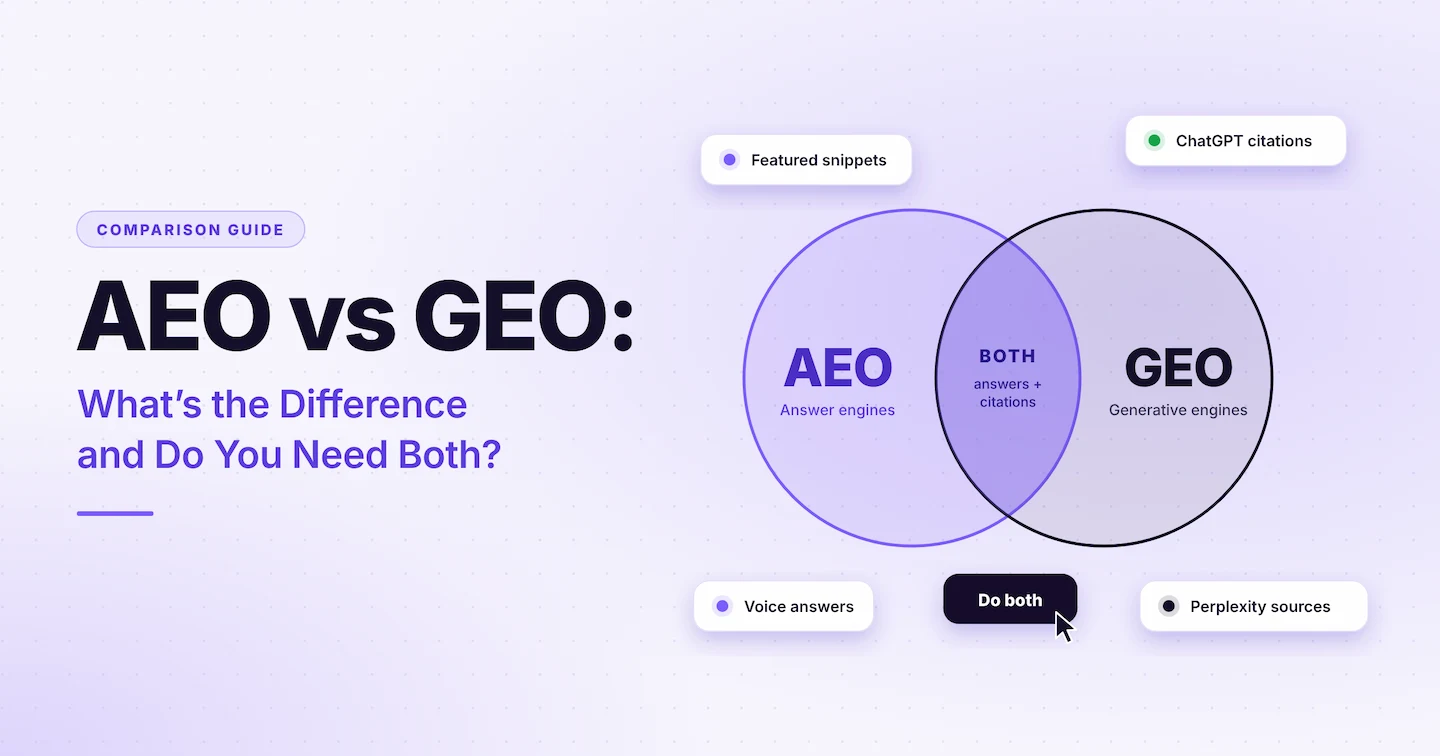
If you have been enthusiastic about SEO, you have probably heard of AEO and GEO. AEO stands for Answer Engine Optimization, while GEO stands for Generative Engine Optimization. Although the terms are used differently, their underlying work overlaps heavily. Both extend traditional SEO into AI-driven search experiences.
AEO: Optimizes content to provide clear and useful answers to user questions.
GEO: Optimizes content for visibility in generative AI responses through mentions, citations, recommendations, and sources.
AEO vs GEO: AEO and GEO have different emphasis, but their optimization practices overlap significantly.
SEO relationship with AEO and GEO: SEO remains the foundation, while AEO and GEO extend search optimization into AI-powered experiences.
Quick optimization guide: Create helpful, trustworthy content that satisfies users first, then optimize and measure its visibility across search and AI experiences.
What Is an Answer Engine?
An answer engine is a system that understands a user's query and provides a direct, synthesized response instead of simply returning a list of ranked links.
Examples include ChatGPT, Gemini, Perplexity, Google AI Overviews, and Google AI Mode. While search engines primarily help people find sources, answer engines aim to give them an answer directly.
What Is AEO?
AEO, or Answer Engine Optimization, is the practice of optimizing content so answer engines can understand, select, and use it when responding to users’ questions. Traditional SEO focuses primarily on improving a webpage’s visibility in search results; AEO focuses more on making content useful for systems that provide answers instead of simply showing a list of links.
Answer engines are AI-powered systems that understand what a user is asking and provide a direct answer. They can find relevant information and bring it together into an answer within search or conversation.
As search evolves from simply finding webpages to providing direct answers, AEO focuses on making information clear, relevant, well-structured, and trustworthy. The goal is answer visibility: making content useful and accessible enough to potentially be selected, mentioned, or cited when an answer engine responds to a relevant query.
In practice, AEO means creating people-first content that directly addresses user questions, provides useful context, demonstrates expertise, and remains technically accessible to search and AI systems.
What Is a Generative Engine?
A generative engine is an AI-powered system that generates a response by synthesizing information from retrieved sources, rather than simply displaying those sources as search results.
The key word is “generative.” The system interprets the query, retrieves relevant information, and uses a generative model to produce a new response. Examples include ChatGPT, Gemini, Perplexity, Google AI Overviews, and Google AI Mode.
Many of the same platforms can be described as both answer engines and generative engines because they provide direct answers by generating responses from retrieved information. In simple terms, an answer engine describes what the system does for the user; a generative engine describes how it produces the response.
What Is GEO?
GEO, or Generative Engine Optimization, is the practice of optimizing content to improve its visibility in generative AI responses. Traditional SEO focuses on getting webpages to rank in search results; GEO focuses on helping content become a useful source that AI systems can discover, understand, and potentially mention or cite when generating an answer.
Generative engines retrieve information from different sources and synthesize it into a new response. GEO focuses on making content relevant, trustworthy, informative, and easy for AI systems to understand and use.
The goal of GEO is generative search visibility: increasing the chances that a brand, content, or information appears within relevant AI-generated responses through mentions, citations, recommendations, or links.
AEO vs GEO: The Key Differences
- Full form: Answer Engine Optimization vs Generative Engine Optimization.
- Main emphasis: AEO makes content easy to understand, extract, and use as an answer. GEO makes content useful as a source for AI-generated responses.
- Primary goal: AEO increases visibility when an answer engine provides a direct answer. GEO increases visibility through mentions, citations, recommendations, or links.
- Content focus: AEO favors clear, direct, self-contained answers. GEO favors context-rich, authoritative, and evidence-supported information.
- Optimization focus: AEO emphasizes clarity, structure, relevance, and extractability. GEO emphasizes authority, semantic depth, originality, and source credibility.
- Query type: AEO often targets specific questions and direct information needs. GEO often supports broader, conversational, complex, or multi-step queries.
- Success metrics: AEO can be measured through answer inclusion and answer visibility. GEO can be measured through citation rate, mention frequency, recommendations, and AI share of voice.
Both approaches build on traditional SEO. They are different lenses on related search experiences, not two completely separate disciplines.
How AEO and GEO Visibility Can Be Measured
Measuring AEO and GEO visibility is different from measuring traditional SEO. Instead of looking only at rankings and organic clicks, you need to see whether and how content appears in AI-generated answers.
AEO visibility
- Answer inclusion: Whether content appears in an AI-generated or answer-focused result.
- Mention frequency: How often the brand or content is mentioned.
- Citation: Whether the system attributes information to the website.
- Source link: Whether users can access the page from the generated answer.
GEO visibility
- AI mentions: How often the brand appears in relevant responses.
- Citation frequency: How often the website is referenced as a source.
- Share of voice: How frequently the brand appears compared with competitors across a defined set of queries.
- Recommendations: Whether an AI system recommends the brand or product for relevant options.
- Links and referrals: Whether generated responses direct users back to the website.
How AEO and GEO Work Together
AEO and GEO work together because the same content can serve both answer-focused and generative search experiences. You do not need separate strategies for each.
The foundation is simple: do traditional SEO well first, then build on it with AEO and GEO. Content should be useful, clear, relevant, authoritative, technically accessible, and easy for both people and search systems to understand.
Do traditional SEO well first
- Make the website crawlable, indexable, technically sound, and supported by helpful, relevant content.
- Keep important pages accessible and connected through clear internal linking.
Make content answer-friendly
- Answer user questions clearly.
- Use descriptive headings and self-contained explanations.
- Provide enough context to satisfy search intent instead of forcing users to assemble the answer themselves.
Build authority and originality
- Support important claims with reliable evidence.
- Add first-hand experience, expert insights, original research, or unique perspectives.
- Make it clear who created the content and why the source is trustworthy.
Optimize for AI visibility
- Track mentions, citations, recommendations, and links across AI-driven search experiences.
- Review which pages and claims are being surfaced and where competitors are cited instead.
Treat them as one strategy
Think of SEO as the foundation, with AEO and GEO extending that foundation into AI-powered search.
Tools for AEO and GEO
AEO and GEO tools help you understand how your brand and content appear across AI-powered search and answer experiences. Common signals include mentions, citations, visibility, competitors, and the sources appearing in AI responses.
- FixRank AI: Combines technical SEO, search intelligence, semantic analysis, content quality, internal linking, and AI visibility to identify and prioritize opportunities.
- Profound: AI visibility and generative search analytics with a focus on enterprise monitoring and competitive intelligence.
- Otterly.AI: Tracks brand visibility, mentions, citations, and share of voice across multiple AI search experiences.
- Peec AI: Focuses on AI visibility tracking, competitor benchmarking, prompt monitoring, and citation analysis.
- Scrunch AI: Combines AI visibility monitoring with analysis of how AI systems access and interpret content.
- Semrush AI Visibility Toolkit: Adds AI visibility tracking to the broader Semrush SEO ecosystem.
- Ahrefs Brand Radar: Extends Ahrefs into AI visibility and brand-mention monitoring.
AEO vs GEO: Which Strategy Should You Use?
You do not have to choose between AEO and GEO. They overlap heavily, and the same content can support both.
Start with traditional SEO as the foundation, then create content that directly answers user questions while providing the depth, evidence, and context that can make it useful for AI-generated responses.
Give more attention to AEO when
- Content targets specific questions and direct answers.
- You create FAQs, definitions, how-to guides, or comparisons.
- The priority is making information clear and easy to understand.
Give more attention to GEO when
- You want greater visibility in generative AI responses.
- Content includes original insights, research, data, or expertise.
- You want to track mentions, citations, recommendations, and source links.
Common AEO and GEO Mistakes to Avoid
- Ignoring traditional SEO: AEO and GEO do not replace crawlability, indexability, and helpful content.
- Treating them as completely separate strategies: AEO and GEO overlap heavily, and the same content can support both.
- Creating content just for AI: Focus on original, helpful, reliable, people-first content rather than optimizing only for AI systems.
- Chasing every possible query: Focus on underlying search intent instead of creating separate content for every variation.
- Relying on llms.txt: It is not required for Google Search and does not provide a special ranking advantage.
- Optimizing without measuring: Track mentions, citations, recommendations, and source links, not just traditional rankings.
SEO vs AEO vs GEO
- SEO: Ranks content in search results through relevance, depth, authority, technical health, and links.
- AEO: Provides useful answers through clarity, relevance, answerability, and content structure.
- GEO: Gains visibility in AI-generated responses through evidence, context, authority, originality, mentions, citations, and recommendations.
SEO, AEO, and GEO focus on different aspects of search visibility, but they overlap significantly. SEO provides the foundation, while AEO and GEO extend it into answer-focused and AI-powered search experiences.
Frequently Asked Questions
Are AEO and GEO the same thing?
Not exactly. The terms emphasize different aspects of AI search, but their optimization practices overlap heavily.
Should you do SEO, AEO, and GEO together?
Yes. SEO provides the foundation, while AEO and GEO extend SEO into answer-focused and generative AI search experiences.
Does AEO replace SEO?
No. AEO complements SEO by focusing more on how content can provide useful answers in answer-focused search experiences.
Does GEO replace SEO?
No. GEO complements SEO by focusing on visibility within generative AI responses.
Which is better, AEO or GEO?
Neither is universally better. AEO and GEO serve overlapping purposes, so the right focus depends on your content, audience, and search visibility goals.
Is GEO part of SEO?
Yes. For Google Search, GEO-related optimization is closely connected to SEO. Established SEO practices remain relevant to visibility in generative AI search experiences.
Conclusion
AEO and GEO are not replacements for SEO. They are ways to adapt your search strategy as people increasingly discover information through AI-powered answers and generative search.
The foundation remains the same: create useful, trustworthy content, make the website technically accessible, and understand what the audience is searching for. Then measure how the brand and content appear across both traditional and AI-powered search.
Want to see how your website performs across search and AI visibility? Try the FixRank AI free audit to identify SEO and AI visibility opportunities and find actionable fixes.
Ready to Fix Your SEO Automatically?
Discover technical issues, improve AI visibility, optimize internal links, and unlock measurable ranking growth with FixRank AI.
Start Free Audit