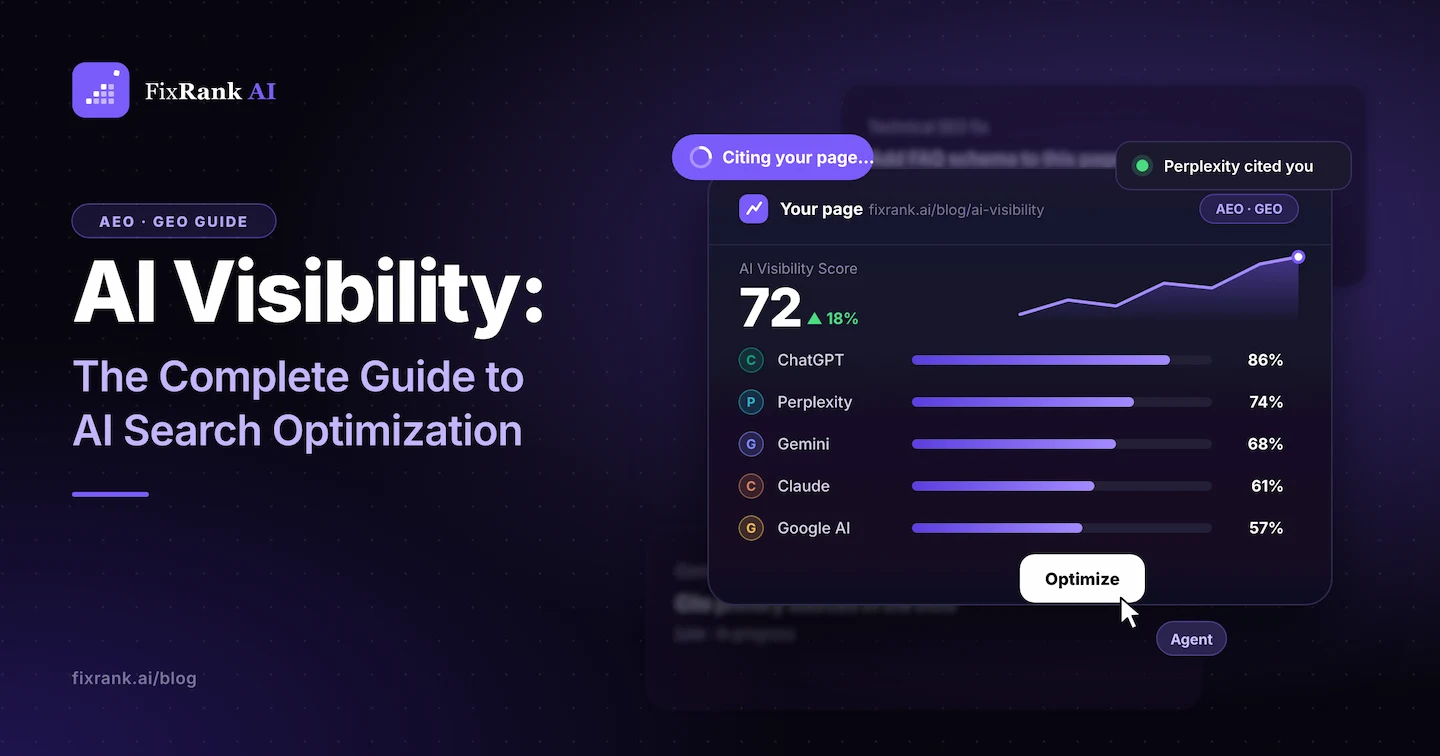
Learn what AI visibility is, how AI search finds sources, what influences visibility, and how to improve and measure your brand presence in AI search.
What Is AI Visibility?
Search is changing. People increasingly want answers to specific problems without clicking multiple blue links or reading long articles to find what they need.
AI visibility is your brand’s ability to appear and be accurately represented in AI-generated answers when people search for topics, problems, products, or solutions related to your business.
In traditional SEO, visibility is mainly about where pages rank in search engine results. In AI search, a brand can be mentioned, cited, recommended, or linked as a source in an answer.
For example, someone searching for the best AI SEO tools may get an answer directly from Google AI Overviews, AI Mode, ChatGPT, or Perplexity instead of clicking through multiple search results. If your brand appears in that answer, you have AI visibility.
A mention is not the same as a citation, and a citation is not the same as a recommendation. AI visibility is about how often your brand appears, how accurately it is represented, which sources support it, and whether users can discover your website through the answer.
In simple terms, the goal is to be discoverable, understandable, relevant, trustworthy, and useful enough for AI systems to include in their answers.
AI Mention vs. Citation vs. Recommendation
These are different ways a brand can appear in an AI-generated answer:
- AI mention: The AI names your brand. For example, “FixRank AI is an AI SEO tool.” This shows that the system knows your brand.
- AI citation: The AI uses your content as a source and links to it. For example, “FixRank AI monitors AI visibility” followed by a source link.
- AI recommendation: The AI suggests your brand as a relevant solution. For example, “FixRank AI is a good option for monitoring AI visibility.”
How AI Search Finds and Selects Sources
AI search does more than match keywords with webpages. It uses what the system already knows and, when available, information from the live web to understand a question, find useful sources, and generate an answer.
The exact process varies between platforms, but it generally follows these steps.
1. Understand the query
AI looks at the meaning, intent, and context of a question. For complex questions, it may break the query into smaller related searches to explore different parts of the topic. This is known as query fan-out.
2. Retrieve relevant sources
The system searches its available information sources to find content that may help answer the query. For web-enabled AI search, this can include webpages, videos, databases, and other online sources.
3. Find the most relevant information
AI systems can identify specific passages or sections that contain useful information rather than treating every page as equally relevant. Clear, direct, and well-supported content makes it easier to find the needed information.
4. Evaluate the sources
Retrieved information may be evaluated using relevance, quality, authority, freshness, and supporting evidence. Not every source that is found will necessarily be used in the final answer.
5. Generate the answer
The system combines relevant information and generates a direct answer. Depending on the platform, it may also provide citations or links to the sources used. This is why AI visibility is more than ranking for a keyword: content needs to be relevant, accessible, clear, trustworthy, and useful enough to retrieve and reference.
What Influences AI Visibility?
There is no single factor that determines whether a brand appears in an AI-generated answer. AI visibility depends on how easily systems can find, understand, evaluate, and use information about a brand.
1. Technical accessibility
AI systems need to access and understand a website before they can use its content. Crawlability, indexability, internal linking, accessible content, and clear page structure help make information easier to discover and process.
2. Content quality and relevance
Content should provide accurate, useful, and relevant information that directly answers what people are searching for. Original research, first-hand experience, expert insights, and useful analysis can make content more valuable.
3. Content structure
AI systems may retrieve specific passages rather than use an entire page. Clear headings, concise answers, lists, tables, and well-structured sections make important information easier to identify and understand.
4. Topical and semantic relevance
AI needs to understand how a brand, its topics, products, and concepts are connected. Comprehensive topic coverage, relevant internal links, consistent terminology, and strong semantic relationships can help establish topical authority.
5. Entity signals
AI systems need to understand who a brand is, what it offers, and which topics or categories it is associated with. Consistent information across a website and relevant external sources can strengthen these signals.
6. Authority and trust
Reliable answers require reliable sources. Author expertise, supporting evidence, reputable references, original data, and trusted third-party mentions can help establish credibility.
7. Brand mentions and citations
A website is not the only source AI systems use to understand a brand. Mentions and citations from relevant third-party sources can establish relevance, authority, and reputation. These may include reviews, industry publications, directories, comparison articles, community discussions, and other trusted websites.
8. Freshness and accuracy
Outdated information can become less useful, especially for topics that change frequently. Keep pricing, features, statistics, product details, and industry information accurate and up to date.
9. Traditional SEO
AI visibility builds on traditional SEO rather than replacing it. Technical SEO, content quality, relevance, internal linking, and authority still provide an important foundation for being discovered in AI-powered search.
AI SEO is not about abandoning traditional SEO. It extends the SEO foundation to optimize for AI-generated answers, citations, and recommendations.
10. Query and platform context
AI visibility is not fixed. Results can change depending on the query, platform, location, available sources, and whether live web search is being used. User preferences, previous searches, memory, or other personal context can also influence a response.
How to Improve Brand Visibility in AI
Improving brand visibility in AI is not about finding a single trick that makes AI systems mention a brand. The goal is to make the brand easy to find, understand, trust, and reference when AI systems generate answers.
1. Make your website easy to crawl
- Keep important pages crawlable and indexable.
- Maintain a clear website structure and logical internal links.
- Fix broken links, incorrect canonicals, and blocked resources.
- Make important content accessible without unnecessary technical barriers.
2. Create content that answers real questions
- Build content around the questions, problems, and needs of your audience.
- Give the answer clearly instead of hiding it behind a long introduction.
- Add examples, data, expert insights, and practical recommendations where they improve the answer.
- Focus on satisfying user intent rather than simply adding more keywords.
3. Structure content for easy retrieval
- Use descriptive H2s, H3s, and other headings.
- Keep important answers clear and relatively concise.
- Use lists, tables, definitions, and FAQs when they make information easier to understand.
- Make important sections useful even when retrieved separately from the rest of the page.
4. Build topical authority
- Cover the main topic and important related subtopics.
- Answer different questions across the user's search journey.
- Connect related content with contextual internal links.
- Build enough depth for search engines and AI systems to understand what the brand knows and what it is relevant to.
5. Strengthen your brand entity
- Clearly explain who the brand is, what it offers, and who it serves.
- Keep important brand and product information consistent across the website and external sources.
- Build clear connections between the brand, products, services, and relevant topics.
- Make it easy for AI systems to distinguish the brand from similarly named entities.
6. Demonstrate expertise and trust
- Show first-hand experience and relevant expertise.
- Support important claims with reliable evidence and references.
- Publish original research, data, case studies, or expert insights where possible.
- Keep authorship and other important trust signals clear.
7. Earn relevant brand mentions
Build a presence beyond your own website through relevant publications, industry websites, review platforms, comparison sites, and communities. Prioritize relevant and trustworthy sources over large numbers of low-quality mentions.
8. Create content worth citing
Publish original statistics, research, data, useful frameworks, comparisons, studies, and resources. Include insights that other websites can reference, and support important claims with clear evidence.
9. Keep important information fresh
Regularly update pricing, features, statistics, research, and comparisons. Correct outdated information and keep important product and business information consistent across sources.
10. Optimize for different AI experiences
Test the brand across Google AI Overviews, Google AI Mode, ChatGPT, Perplexity, Gemini, and Claude. Test informational, commercial, comparison, and problem-based queries rather than only branded searches. Visibility can vary by platform, query, location, and user context.
11. Monitor your AI visibility
Track more than whether the brand appears. Monitor:
- Brand mentions
- AI citations
- Recommendations
- Linked sources
- Competitor visibility
- Sources used in AI answers
- Brand accuracy
- Changes over time
12. Turn AI visibility data into action
Find queries where competitors appear but your brand does not. Identify the sources supporting competitor mentions and recommendations. Compare their content, topical coverage, authority, and brand presence with yours, then improve the relevant content or brand signals and recheck the same prompts.
How to Measure AI Visibility
1. AI Mention Rate
AI Mention Rate measures how often a brand appears in AI-generated answers across a defined set of relevant prompts. If a brand appears in 35 of 100 relevant prompts, its AI Mention Rate is 35%.
2. AI Citation Rate
AI Citation Rate measures how often a website or domain is cited as a source across a defined set of AI answers. If a website is cited in 20 of 100 eligible AI answers, its citation rate is 20%. Measure this within a specific platform and mode where citations are actually available.
3. AI Recommendation Rate
AI Recommendation Rate measures how often AI systems recommend a brand when users ask for products, services, or solutions in a category.
4. AI Share of Voice
AI Share of Voice measures how much of the AI-generated conversation a brand captures compared with competitors for a defined set of prompts.
AI Share of Voice = Your Brand Mentions ÷ Total Brand Mentions × 100
5. Citation sources
Citation Sources show which websites and pages AI systems use to support answers about a brand or category. Tracking these sources reveals where AI systems get their information and where there may be opportunities to strengthen a brand’s presence.
6. Brand accuracy
Brand Accuracy measures whether AI systems describe a brand and its products or services correctly, including features, pricing, positioning, target audience, and product category.
7. Prompt coverage
Prompt Coverage measures how consistently a brand appears across relevant prompts and search scenarios, including informational, problem-based, commercial, comparison, recommendation, and brand-specific prompts.
Use AI Visibility Tools
AI visibility tools help organize AI search data and identify mentions, citations, recommendations, competitors, and visibility changes. A useful tool can track:
- AI brand mentions
- AI citations
- AI recommendations
- AI Share of Voice
- Citation sources
- Brand accuracy
- Competitor visibility
- Prompt performance
- Platform performance
- Visibility trends
Manually checking ChatGPT, Perplexity, Google AI Overviews, and other AI platforms can help understand individual results, but it becomes difficult to do at scale. Monitoring tools make it easier to track the same prompts consistently, compare competitors, identify citation sources, and monitor changes over time.
Use FixRank AI for Visibility
FixRank AI connects technical SEO, Google Search, AI visibility, semantic SEO, content quality, and internal linking to analyze the signals affecting search performance.
It connects ranking signals to find content gaps, semantic opportunities, and issues that may be holding pages back. By improving content quality, relevance, topic coverage, and semantic relationships, FixRank helps make content easier for search engines and AI systems to understand and retrieve.
Instead of treating search rankings and AI visibility as separate goals, FixRank connects search intelligence → semantic analysis → content optimization → AI visibility, helping identify and act on opportunities across Google and AI-powered search.
Conclusion
AI search is changing how people discover information, compare solutions, and choose brands. Ranking in traditional search is still important, but it is no longer the only way a brand can become visible.
To improve AI visibility, make your brand easy to find, understand, trust, and reference. Strong technical SEO, useful and well-structured content, topical authority, clear entity signals, original information, relevant brand mentions, and accurate information all contribute to that foundation.
AI visibility should not be treated as a one-time optimization. Measure where your brand appears, identify where competitors are more visible, improve the gaps, and continue monitoring the results.
The goal is simple: don’t just rank in search. Build a brand that AI systems can understand, trust, and confidently include in their answers.
Frequently Asked Questions
Is AI SEO different from traditional SEO?
Yes, but AI SEO does not replace traditional SEO. Traditional SEO provides the foundation, while AI SEO focuses on visibility in AI-generated answers, citations, and recommendations.
How can I improve my AI visibility?
Start with the basics: improve technical SEO, content quality, topical relevance, structure, authority, brand mentions, and entity signals. Then monitor visibility and identify gaps compared with competitors.
How do I measure AI visibility?
Track metrics such as AI Mention Rate, AI Citation Rate, AI Recommendation Rate, AI Share of Voice, Prompt Coverage, and Brand Accuracy across relevant AI platforms.
Can my brand appear in AI answers without being cited?
Yes. An AI system may mention or recommend a brand without linking to its website. A citation specifically means that a website or another source is provided as supporting evidence.
How long does it take to improve AI visibility?
There is no fixed timeframe. Results depend on existing authority, content, technical foundation, competition, platform, and query. AI visibility should be treated as an ongoing optimization process rather than a one-time task.
Ready to Fix Your SEO Automatically?
Discover technical issues, improve AI visibility, optimize internal links, and unlock measurable ranking growth with FixRank AI.
Start Free Audit