Compare the best tools for monitoring ChatGPT brand mentions, citations, competitors, prompts, and AI search visibility in 2026.
ChatGPT is becoming an important discovery channel for brands, but traditional SEO rank trackers cannot tell you how often your brand appears in AI-generated answers. That is where ChatGPT mention monitoring and AI visibility tools come in.
These tools help you track brand mentions, citations, competitors, prompts, and visibility across ChatGPT and other AI search platforms. In this guide, we compare the leading options and explain what each one is best suited for.
TL;DR: Best ChatGPT Mention Monitoring Tools
There is no single universal “ChatGPT ranking” equivalent to a Google position. Modern platforms typically measure AI visibility, mentions, citations, Share of Voice, prompt-level presence, and competitor visibility.
- Ahrefs Brand Radar: Best for large-scale AI visibility research.
- Semrush AI Visibility Toolkit: Best for combining AI visibility with traditional SEO.
- Profound: Best for enterprise AI search intelligence and execution.
- Peec AI: Best for focused AI visibility analytics and citation insights.
- Otterly.AI: Best for multi-engine AI search monitoring and GEO optimization.
- SE Ranking: Best for combining SEO rank tracking with AI visibility.
- Scrunch: Best for AI search visibility and competitive monitoring.
- Beamtrace: Best for ChatGPT-focused monitoring.
- Indexly: Best for AI visibility and optimization workflows.
- Geoptie: Best for focused ChatGPT and AI engine tracking.
Quick Comparison: Best ChatGPT Mention Monitoring Tools
| Tool | Best for | Starting price |
|---|---|---|
| Ahrefs Brand Radar | Large-scale AI visibility research | $199/mo |
| Semrush AI Visibility Toolkit | Traditional SEO plus AI visibility | $199/mo |
| Profound | Enterprise AI search intelligence | $99/mo |
| Peec AI | AI visibility analytics | $95/mo |
| Otterly.AI | Multi-engine monitoring and GEO | $29/mo |
| SE Ranking | SEO and AI visibility tracking | Varies by plan |
| Scrunch | AI visibility and competition | Varies by plan |
| Beamtrace | ChatGPT monitoring | Varies by plan |
| Indexly | AI visibility and optimization | Varies by plan |
| Geoptie | Focused AI engine tracking | Varies by plan |
Prices and feature limits can change. Confirm current pricing, platform coverage, prompt limits, and data retention before purchasing.
Best ChatGPT Mention Monitoring and Rank Tracking Tools
1. Ahrefs Brand Radar — Best for Large-Scale AI Visibility Research
Ahrefs Brand Radar helps businesses understand how often brands appear in AI-generated answers. It supports major AI platforms including ChatGPT, Google AI Overviews, Google AI Mode, Perplexity, Gemini, and Microsoft Copilot.
Key features
- AI visibility tracking and brand mentions.
- Citation discovery for pages and domains used by ChatGPT.
- AI Share of Voice and competitor benchmarking.
- Custom prompt tracking and historical monitoring.
- Large-scale research across search-backed prompts.
What we like
Its large AI visibility dataset makes it useful for market research beyond a small manually tracked prompt set. The connection with the wider Ahrefs SEO ecosystem also helps teams compare traditional search performance with AI visibility.
What could be better
Pricing can increase as you add platforms and custom prompt checks. Each prompt run can use a check, so large monitoring programs need careful budgeting.
Pricing
The document’s pricing reference starts at $199 per month for one AI platform, with broader plans and additional custom prompt checks available at higher tiers. Verify the current plan details before publication or purchase.
2. Semrush AI Visibility Toolkit — Best for Combining Traditional SEO with AI Visibility
Semrush AI Visibility Toolkit connects brand mentions, citations, sentiment, and Share of Voice with traditional SEO, competitor research, prompt tracking, and Site Audit workflows.
Key features
- Visibility monitoring across ChatGPT, Google AI Overviews, Google AI Mode, Gemini, and Perplexity.
- Brand mentions, citations, sentiment, and AI Share of Voice.
- Prompt research and custom prompt tracking.
- Competitor research and AI Search Site Audit.
- Connections between AI visibility and traditional SEO data.
What we like
Semrush is a natural fit for teams that already manage keyword research, technical SEO, and competitor analysis in the same platform. Its prompt research can also reveal topics where competing brands appear in AI answers.
What could be better
Prompt limits and additional domain or prompt costs may matter for larger programs. AI Visibility may also be a separate toolkit from some core Semrush subscriptions.
Pricing
The provided outline lists Starter at $199 per month, Pro+ at $299 per month, and Advanced at $549 per month, with lower effective monthly prices on annual billing. Confirm current pricing and inclusions directly with Semrush.
3. Profound — Best for Enterprise AI Search Intelligence
Profound combines AI visibility monitoring, prompt research, citation analysis, page-level content intelligence, AI traffic analytics, and AI-assisted execution.
Key features
- Visibility, Share of Voice, Average Position, and citation tracking.
- ChatGPT monitoring and prompt-level analysis.
- Prompt volume research across ChatGPT, Gemini, Claude, and Perplexity.
- Sentiment and fact-checking workflows.
- Page health, AEO readiness, and AI bot activity.
- Agent analytics, custom dashboards, projects, and reporting.
- AI Marketer and Agents for research and optimization workflows.
What we like
Profound connects monitoring with execution. Its citation and page-level insights can help teams move from “where are we mentioned?” to “which pages influence those answers, and what should we improve?”
What could be better
The platform has a large feature set and may take more time to learn. Pricing and platform coverage vary by plan, and broader enterprise coverage can become expensive.
Pricing
The outline lists a free Brand Trial, custom Brand Enterprise pricing, Agency Growth at $99 per month, and Client Workspace as a $399 per month add-on. Confirm current terms and feature availability with Profound.
4. Peec AI — Best for AI Visibility Analytics
Peec AI focuses on helping marketing and SEO teams understand how brands appear in AI-generated answers. It tracks visibility, position, sentiment, Share of Voice, citations, and competitors.
Key features
- ChatGPT and other AI visibility tracking.
- Prompt research and demand discovery.
- URL- and domain-level citation analysis.
- Competitor benchmarking and brand perception analysis.
- Content gap analysis.
- CSV or JSON exports and Looker Studio integration.
- Enterprise API and SSO options.
What we like
Peec AI is focused on measurement and makes visibility, citation, and competitor data easier to review. Unlimited user seats can also help teams and agencies collaborate.
What could be better
It focuses more on monitoring and analysis than direct content or SEO execution. Historical data starts when tracking begins, and broader model coverage may require paid add-ons.
Pricing
The provided pricing reference lists Starter at $95 per month, Pro at $245 per month, Advanced at $495 per month, and custom Enterprise pricing. Confirm the current plans before using these figures commercially.
5. Otterly.AI — Best for Multi-Engine AI Search Monitoring
Otterly.AI monitors visibility across ChatGPT, Google AI Overviews, Google AI Mode, Perplexity, Gemini, Microsoft Copilot, and Claude. It combines monitoring with prompt research, competitor tracking, GEO audits, and recommendations.
Key features
- Brand mentions, rankings, citations, sentiment, and Share of AI Voice.
- Prompt research from keywords, topics, competitors, and website content.
- Citation and content gap analysis.
- Competitor benchmarking and location monitoring.
- GEO audits and prioritized recommendations.
- AI crawler and agent analytics.
- API, MCP, and Looker Studio integrations.
What we like
Otterly.AI brings several AI search engines into one monitoring workflow and goes beyond reporting with recommendations, GEO auditing, and crawler analytics.
What could be better
Lower plans may limit prompts, platforms, or historical data. The broad feature set can also make the product more involved to configure, and recommendations still need human review and implementation.
6. SE Ranking / SE Visible — Best for SEO Plus AI Visibility Tracking
SE Ranking and its AI visibility capabilities are designed for teams that want traditional SEO tracking alongside monitoring of ChatGPT, Gemini, Perplexity, Google AI Overviews, and Google AI Mode.
Key features to compare
- Traditional keyword and ranking tracking.
- AI mentions and visibility signals.
- Sentiment and Share of Voice.
- Competitor benchmarking.
- Multi-platform AI search coverage.
- Reporting alongside existing SEO data.
This option can suit teams that do not want to separate traditional rank tracking from emerging AI visibility work. Compare the exact engine coverage and limits for the plan you need.
7. Scrunch — Best for AI Search Visibility and Competitive Monitoring
Scrunch is positioned around cross-LLM visibility and competitive monitoring. A useful evaluation should look at prompt-level monitoring, Share of Voice, answer inclusion, citation mapping, geographic analysis, and competitor benchmarking.
Scrunch may be a strong fit for teams that need to compare how several brands appear across AI answer engines. Verify the current platform list, historical data, reporting, and pricing before selecting it.
8. Beamtrace — Best for ChatGPT-Focused Monitoring
Beamtrace is included for readers whose primary need is focused ChatGPT monitoring. Relevant capabilities to evaluate include:
- ChatGPT rank tracking.
- ChatGPT brand mention tracking.
- ChatGPT visibility and citation tracking.
- Prompt monitoring.
- Competitor visibility.
- Coverage of other AI engines.
This focused approach may be useful when a team wants a narrower workflow rather than a large enterprise SEO suite. Confirm the available plans and engine coverage before purchase.
9. Indexly — Best for AI Visibility and Optimization
Indexly is positioned as an option that connects AI search visibility with optimization. When comparing it, review its coverage of ChatGPT, Perplexity, Gemini, and Claude, along with AI citations, competitor visibility, and the actions it recommends after monitoring.
The most useful optimization tools are the ones that connect a visibility finding to a page, content gap, technical issue, or authority opportunity that a team can actually improve.
10. Geoptie — Best for Focused ChatGPT and AI Engine Tracking
Geoptie is included for teams looking for focused AI engine tracking. Relevant capabilities include ChatGPT, Perplexity, and Claude rank tracking, AI visibility checks, citation source analysis, and competitor monitoring.
Use the same evaluation criteria as any AI visibility platform: check how prompts are sampled, how often results are refreshed, which locations are supported, and whether the tool preserves the response context behind each metric.
ChatGPT Rank Tracking vs Traditional SEO Rank Tracking
Traditional SEO rank tracking measures keywords, search queries, SERP position, ranking URLs, search volume, and search competitors. These metrics are useful because a conventional search result has a relatively stable ordered page of results.
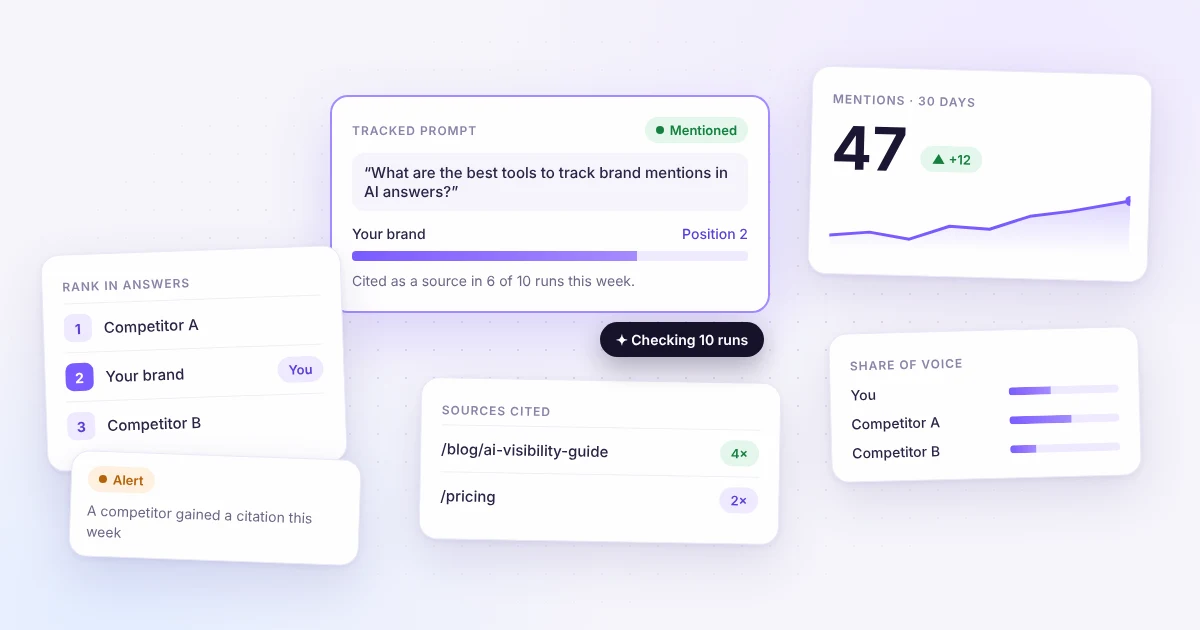
AI visibility tracking measures prompts, brand mentions, answer position, citations, sources, AI Share of Voice, competitor presence, and visibility trends. AI responses can change based on prompt wording, model, location, time, retrieval, and conversation context.
“ChatGPT rank tracker” is a useful search term, but modern AI visibility platforms generally measure more than one fixed ranking position.
What Should a ChatGPT Mention Monitoring Tool Track?
1. Brand mentions
Does the AI answer mention your brand for the prompts that matter to your business?
2. Mention position
Where does the brand appear in the response? Position can indicate prominence, but it should not be treated exactly like a fixed Google ranking.
3. Citations and sources
Which pages and domains does ChatGPT cite? A brand mention and a citation are different signals. Tracking both helps uncover content and authority gaps.
4. Share of Voice
How often does your brand appear compared with competitors across the same prompt set?
5. Prompt-level visibility
Can you identify the informational, comparison, category, and purchase-intent prompts that trigger your mentions?
6. Competitor visibility
Which brands appear when yours does not? Competitor presence can show topics where another company has stronger relevance or authority signals.
7. AI platform coverage
Does the tool monitor ChatGPT, Gemini, Perplexity, Claude, Google AI Overviews, Google AI Mode, and Copilot? Coverage varies by vendor and plan.
8. Historical trends
AI visibility is not a one-time metric. Look for changes in mentions, position, Share of Voice, citations, and sentiment over time.
9. Response context
The tool should let you inspect the prompt, response, timestamp, model or platform, competitors, and cited sources behind a metric. Without this context, a visibility score is difficult to verify or turn into action.
Can You Track Brand Mentions in ChatGPT for Free?
Yes, but free methods usually require more manual work and provide less historical context.
Create a list of relevant prompts and run them consistently. Record whether your brand appears, where it appears, which competitors are mentioned, how the brand is described, and which sources ChatGPT cites. Free trials or limited plans from AI visibility tools can automate part of this process, but they often restrict prompts, projects, platforms, or history.
Manual tracking can be enough for occasional checks. A dedicated paid tool becomes more useful when you need historical trends, competitor benchmarking, citation analysis, multiple locations, and repeatable reporting.
How to Track Brand Mentions in AI Search
Step 1: Build a prompt set
Include category prompts, problem-based prompts, commercial prompts, comparison prompts, and product or service prompts. Keep the prompt set stable enough to identify trends, while adding new prompts when your market changes.
Step 2: Track brand mentions
Record the mention, position, surrounding context, sentiment, citation, timestamp, platform, and model where available.
Step 3: Track competitors
Identify brands that appear alongside yours and brands that appear when yours does not.
Step 4: Analyze citations
Find the pages and domains AI systems use as sources. These citations can reveal content gaps, authority opportunities, and pages that deserve closer analysis.
Step 5: Monitor changes
Track visibility over time rather than relying on one response. AI outputs can vary, so repeated observations are more useful than isolated checks.
Step 6: Turn findings into optimization work
Connect the findings with technical SEO, content quality, semantic relevance, internal linking, authority, and broader search visibility. Monitoring tells you what is happening; optimization helps you decide what to do next.
How to Choose the Right ChatGPT Rank Tracker
Choose based on your workflow:
- Need large-scale AI visibility research? Consider Ahrefs Brand Radar.
- Already use traditional SEO extensively? Consider Semrush or SE Ranking.
- Need enterprise AI search intelligence? Consider Profound.
- Need focused AI visibility analytics? Consider Peec AI.
- Need multi-engine monitoring? Consider Otterly.AI.
- Need competitive AI search monitoring? Consider Scrunch.
- Primarily interested in ChatGPT tracking? Evaluate Beamtrace.
- Want monitoring connected with optimization? Evaluate Indexly.
- Want focused AI engine tracking? Evaluate Geoptie.
Before purchasing, compare model and engine coverage, prompt limits, location support, citation detail, competitor tracking, historical retention, exports, integrations, and renewal pricing.
From AI Visibility Monitoring to SEO Action
Monitoring tells you what is happening. Optimization helps you understand what to improve.
FixRank’s broader positioning connects:
Search Intelligence → Semantic Analysis → Content Optimization → AI Visibility → Actionable Fixes
The monitoring layer asks: “What does AI say about my brand?” The optimization layer asks: “Why might my site be missing from those answers, and what can I improve?” This distinction matters because a mention tracker can expose a visibility gap, while an SEO workflow can help investigate technical health, content relevance, internal linking, and authority signals behind that gap.
Final Takeaway
ChatGPT monitoring is becoming part of AI search visibility measurement. Different tools serve different workflows: Ahrefs supports large-scale research, Semrush and SE Ranking connect AI visibility with SEO, Profound focuses on enterprise intelligence, Peec AI emphasizes analytics, Otterly.AI supports multi-engine monitoring, and other platforms focus on competitive or ChatGPT-specific tracking.
AI visibility should not be reduced to one fixed ranking number. Mentions, citations, competitors, prompts, sources, and trends provide a more complete picture. The goal is not simply to know whether ChatGPT mentions your brand, but to understand why it does, which competitors appear instead, which sources influence the answer, and what you can improve.
Frequently Asked Questions
What is a ChatGPT rank tracker?
A ChatGPT rank tracker monitors where and how often your brand appears in ChatGPT responses for specific prompts. It may track mention position, visibility, Share of Voice, citations, and competitors.
Can you track brand mentions in ChatGPT?
Yes. Specialized AI visibility tools can track brand mentions, position, citations, competitors, sentiment, and visibility across selected ChatGPT prompts.
How do I monitor my brand on ChatGPT?
Create relevant branded, informational, comparison, and purchase-intent prompts. Run them consistently and record mentions, position, competitors, citations, and response context. Dedicated tools automate this process and provide historical tracking.
Can you track ChatGPT rankings like Google rankings?
Not exactly. ChatGPT does not provide a traditional ranking system like Google. Responses can vary by prompt, model, location, and time, so ChatGPT position should be treated as an AI visibility signal rather than a fixed search ranking.
What is the best tool for monitoring ChatGPT brand mentions?
It depends on your workflow. Compare large-scale research, traditional SEO integration, enterprise intelligence, focused analytics, multi-engine monitoring, prompt limits, citations, competitors, and pricing before choosing.
Can I track ChatGPT mentions for free?
Yes. You can manually check relevant prompts and record mentions over time. Free trials and free plans can also provide limited automated tracking, but they usually restrict prompts, platforms, or historical data.
How do I track brand mentions in AI search?
Build a consistent prompt set, monitor mentions and competitors, inspect citations, review the response context, and measure changes over time across the AI platforms relevant to your audience.
What is the difference between ChatGPT rank tracking and AI visibility tracking?
ChatGPT rank tracking focuses mainly on where your brand appears for specific prompts. AI visibility tracking is broader and includes mentions, position, Share of Voice, citations, sentiment, competitors, and multiple AI search platforms.
Can ChatGPT rankings change over time?
Yes. AI responses can change between searches, so brand position and visibility may fluctuate. Monitoring the same prompts consistently helps identify meaningful trends.
Which AI search engines can ChatGPT monitoring tools track?
Depending on the tool and plan, platforms may track ChatGPT, Google AI Overviews, Google AI Mode, Gemini, Perplexity, Microsoft Copilot, and Claude. Coverage varies by vendor and pricing tier.
Ready to Fix Your SEO Automatically?
Discover technical issues, improve AI visibility, optimize internal links, and unlock measurable ranking growth with FixRank AI.
Start Free Audit