Learn how to optimize your website for AI Search with 10 practical steps covering content, technical SEO, AI crawlers, brand authority, and visibility tracking.
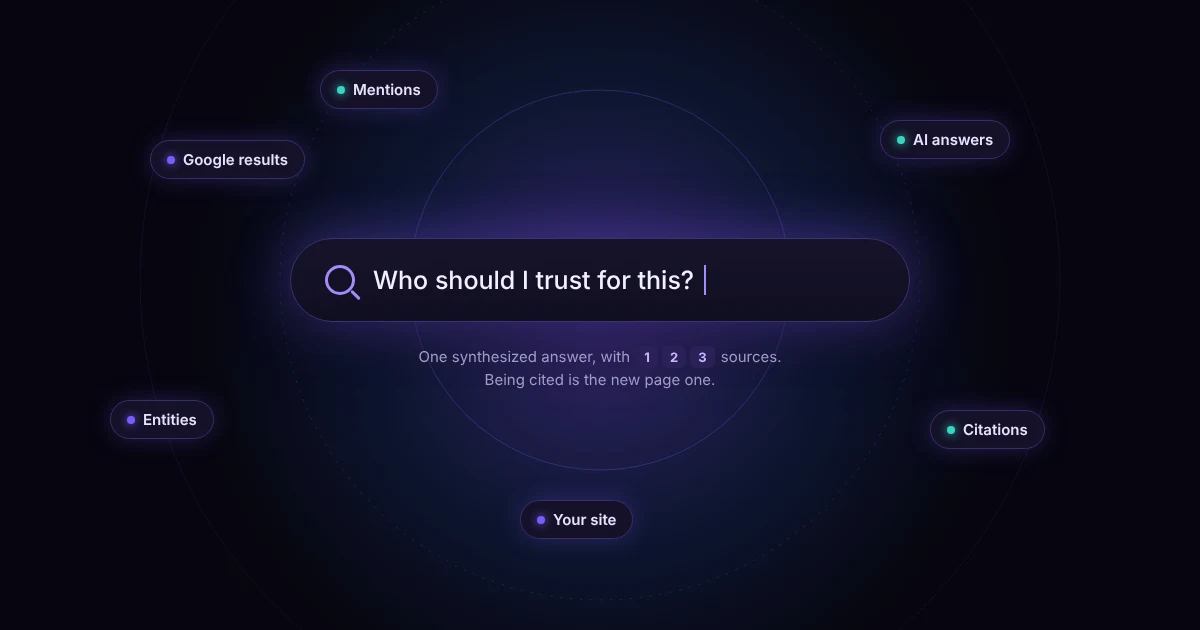
AI search is changing how people discover information, products, and websites. From Google’s AI Overviews and AI Mode to ChatGPT, Claude, and Perplexity, users can find answers through AI-generated responses that cite relevant web pages.
But how do you optimize your website for these experiences? Much of the available advice repeats traditional SEO tips or promotes untested “GEO hacks,” leaving website owners unsure about what actually works.
Research suggests that traditional Google rankings still matter, with many AI Overview citations coming from pages that rank well in Google. However, citation patterns vary by industry and search intent. The most reliable approach is to combine strong SEO fundamentals with original content, technical accessibility, deliberate crawler controls, genuine authority, and measurement.
TL;DR: How to Optimize Your Website for AI Search
- Create original content: Share first-hand experience, expert insights, and useful research instead of repeating existing information.
- Meet search eligibility requirements: Ensure important pages can be crawled, indexed, and displayed in search results.
- Configure AI crawlers: Manage search, user-requested retrieval, and model-training bots according to your goals.
- Fix technical SEO issues: Maintain clean canonical tags, internal links, site architecture, and crawlability.
- Answer questions clearly: Match search intent, cover relevant follow-up questions, and use descriptive titles and URLs.
- Use structured data correctly: Help search engines interpret your content and qualify for eligible rich results.
- Build genuine brand authority: Earn relevant mentions, media coverage, and expert recognition across the web.
- Keep content accurate: Update time-sensitive information when facts, prices, or recommendations change.
- Optimize product and local data: Keep product feeds, business profiles, and essential business information accurate.
- Measure performance: Track organic search, AI referrals, available visibility data, and conversions.
AI Search optimization builds on solid SEO. Focus on useful content, technical accessibility, genuine authority, and measurable results rather than unverified shortcuts.
How AI Search Works
AI search combines large language models, information retrieval, and Retrieval-Augmented Generation (RAG) to generate answers using relevant information from different sources. Although the process varies by platform, it generally includes five stages:
- Query understanding: The AI interprets the user’s intent, context, and question rather than matching keywords alone.
- Query fan-out: For complex queries, the system may generate related subqueries to explore different aspects of the topic.
- Information retrieval: The system retrieves relevant information from web indexes, search engines, or other sources.
- Answer generation: The model synthesizes retrieved information into a conversational answer.
- Citation and linking: When supported, the platform cites or links to source pages so users can verify and explore further.
10 Steps to Optimize Your Website for AI Search
AI search optimization is not about finding shortcuts to get cited by ChatGPT, Google AI Overviews, or Perplexity. It starts with established SEO practices, original content, and making your website accessible to the platforms you want to reach.
1. Create Original Content That Offers Something New
Content should provide original information, useful analysis, and genuine value rather than simply rehashing what others have published. Original content gives readers and AI search systems a reason to consider your website as a source.
To make content more useful:
- Share first-hand experience, original research, and expert insights.
- Include practical examples, product tests, and original data.
- Explain why something works, not just what it is.
- Add a distinct perspective supported by evidence.
- Cite credible sources for important claims and statistics.
For example, instead of publishing another generic website audit guide, analyze real audit findings, explain which technical issues matter most, and show how to prioritize fixes.
2. Meet Google’s AI Search Eligibility Requirements
A page generally needs to be indexed by Google and eligible to appear in Search with a snippet to qualify for links in AI Overviews and AI Mode. Meeting those requirements does not guarantee crawling, indexing, or inclusion in an AI-generated result.
Check that:
- Important pages can be crawled and indexed.
- Canonical tags are correct and duplicate URL issues are resolved.
- The XML sitemap is accurate.
- Indexing and performance are reviewed in Google Search Console.
- Important pages are eligible for normal Search visibility.
Search eligibility is a prerequisite, not a promise of citation. The page still needs to be useful, relevant, and trusted for the query.
3. Configure AI Crawlers Based on Your Goals
AI platforms use different crawlers to discover website content for search, retrieve pages in response to user requests, and collect data for model training. Understanding the difference helps you control how your content is accessed.
| Platform | Search crawler | User-requested retrieval | Model-training crawler |
|---|---|---|---|
| OpenAI | OAI-SearchBot | ChatGPT-User | GPTBot |
| Anthropic | Claude-SearchBot | Claude-User | ClaudeBot |
| Perplexity | PerplexityBot | Perplexity-User | — |
Decide which AI platforms you want to access your website, then review your robots.txt, CDN, firewall, and bot-management rules. Allow relevant search crawlers if you want your content to be discoverable through those services. If you want to restrict model-training access, review the appropriate training crawler separately.
Always verify that crawler rules are working as intended. A robots.txt change, firewall rule, or bot-management setting can affect more than one access path.
4. Maintain a Clean Technical SEO Foundation
AI search features build on search and quality systems. A technically sound website helps search engines discover, crawl, and understand your content, making technical SEO a fundamental part of AI Search optimization.
Prioritize:
- Crawlability and indexability: Make important pages accessible and indexable.
- Canonical tags: Use correct canonical URLs to consolidate duplicate or similar pages.
- Site architecture: Organize pages logically and use descriptive URLs.
- Internal linking: Connect related pages with relevant, descriptive anchor text.
- JavaScript rendering: Ensure important content is accessible when pages are rendered.
- Page experience: Provide a fast, usable experience across devices.
- Duplicate content management: Consolidate unnecessary duplicate pages and resolve conflicting URL signals.
For large or frequently updated websites, review crawl budget so search engines can discover and recrawl important pages efficiently.
5. Structure Content Around Questions and Clear Answers
AI systems may break complex queries into related follow-up questions. Your content should clearly match the main search intent and address relevant questions that users may ask next.
Follow these practices:
- Match the title to search intent.
- Cover relevant follow-up questions.
- Use descriptive headings.
- Write clear URL slugs.
- Answer questions directly before expanding with context and evidence.
- Remove unrelated information and avoid adding sections only to include more keywords.
An article about AI Search optimization could explain how AI search works, how query fan-out affects retrieval, and how to improve content discoverability. Each section should answer a distinct question while supporting the main topic.
6. Use Structured Data for Its Intended Purpose
Schema markup is not a direct ranking factor. When implemented accurately, it helps search engines understand content and can make pages eligible for applicable rich results.
Use the schema type that matches the page:
- Organization for company information.
- Article for blog posts and editorial content.
- Product for product pages.
- LocalBusiness for local business information.
- BreadcrumbList for breadcrumb navigation.
Structured data must accurately reflect visible page content and follow search engine guidelines. There is no special schema markup required to appear in Google AI Overviews or AI Mode, and there is not enough reliable evidence to claim that structured data directly increases citations in other AI search platforms.
7. Build Authority Through Genuine External Mentions
AI search systems can draw on information from across the web, including blogs, videos, and forums. Research has found a correlation between brand mentions and AI visibility, but correlation does not prove that more mentions directly cause higher visibility.
Build a genuine presence by:
- Earning relevant media coverage through newsworthy updates and original research.
- Publishing original data, surveys, and case studies that others can reference.
- Contributing expert insights through publications, interviews, podcasts, and relevant discussions.
- Participating in communities by answering questions helpfully.
- Keeping your company name, product descriptions, and key facts consistent across important profiles.
Avoid buying links, manufacturing brand mentions, or creating fake discussions. Manipulative promotion can violate spam policies and create unreliable brand information.
8. Keep Time-Sensitive Content Accurate and Current
Retrieval systems can use relevant, up-to-date pages to ground AI-generated responses. Accuracy and freshness are especially important for content covering current events, product features, pricing, regulations, and recent research. Not every page needs frequent updates, though.
Review important pages regularly:
- Verify statistics, facts, and source links.
- Recheck product details, features, pricing, and comparisons.
- Refresh examples and instructions when circumstances change.
- Correct factual errors when new evidence becomes available.
- Maintain publication and modification dates accurately when relevant.
Prioritize pages where outdated information could mislead readers or affect their decisions. Do not change publication dates without making substantial improvements.
9. Optimize Product and Local Business Information
Accurate product and business information helps search systems understand and display relevant details.
For ecommerce websites:
- Keep product titles, descriptions, prices, and availability up to date.
- Make sure the Merchant Center feed matches the website.
- Use accurate Product structured data.
- Follow the applicable product data and listing guidelines.
For local businesses:
- Keep the Business Profile name, address, phone number, and opening hours accurate.
- Verify that services and business categories reflect what you offer.
- Maintain consistent information across your website and relevant directories.
10. Measure AI Search Visibility and Improve Based on Evidence
Track how people discover your website through traditional search and AI platforms. Use the data to identify opportunities rather than treating any single third-party score as absolute truth.
- Google: Use available Search Console reporting for AI Overviews and AI Mode.
- ChatGPT: Track referral traffic in your analytics platform; referrals may include
utm_source=chatgpt.com. - Perplexity and Claude: Monitor referral traffic and periodically test relevant queries for mentions and citations.
- Across channels: Track organic clicks and impressions, AI visibility where measurable, referral traffic, conversions, and cited URLs.
Third-party AI visibility tools can support research and monitoring, but they should be used alongside first-party analytics and actual response context. An llms.txt file or special AI markup is not a guaranteed requirement for generative AI Search features.
Common AI Search Optimization Myths
Myth 1: There is one shortcut that guarantees citations
No checklist can guarantee that an AI platform will cite a website. Make content easy to discover, understand, verify, and trust instead.
Myth 2: AI Search replaces traditional SEO
AI Search builds on retrieval, indexing, quality, and relevance systems. Crawlability, useful content, good architecture, and authority still matter.
Myth 3: Structured data automatically produces AI citations
Structured data helps search engines interpret content and may support eligible rich results, but it is not a guaranteed citation mechanism.
Myth 4: Every page needs constant updates
Update pages when facts, products, prices, regulations, or recommendations change. Do not make superficial edits simply to create a newer date.
Myth 5: More brand mentions always mean better visibility
Relevant and accurate mentions can support authority, but the relationship is not a guaranteed causal ranking formula. Prioritize useful expertise and trustworthy references.
Final Takeaway
Optimizing for AI Search is an extension of proven SEO practices, not a replacement for them.
Focus on creating original, helpful content, maintaining a technically accessible website, managing crawler access deliberately, building genuine brand authority, and keeping information accurate. No checklist can guarantee that an AI platform will cite your website.
The goal is to make your content easy to discover, understand, and trust when search systems look for relevant information. Prioritize improvements that benefit your audience, then measure what works across traditional search and AI platforms instead of chasing unverified AI SEO shortcuts.
Ready to Fix Your SEO Automatically?
Discover technical issues, improve AI visibility, optimize internal links, and unlock measurable ranking growth with FixRank AI.
Start Free Audit