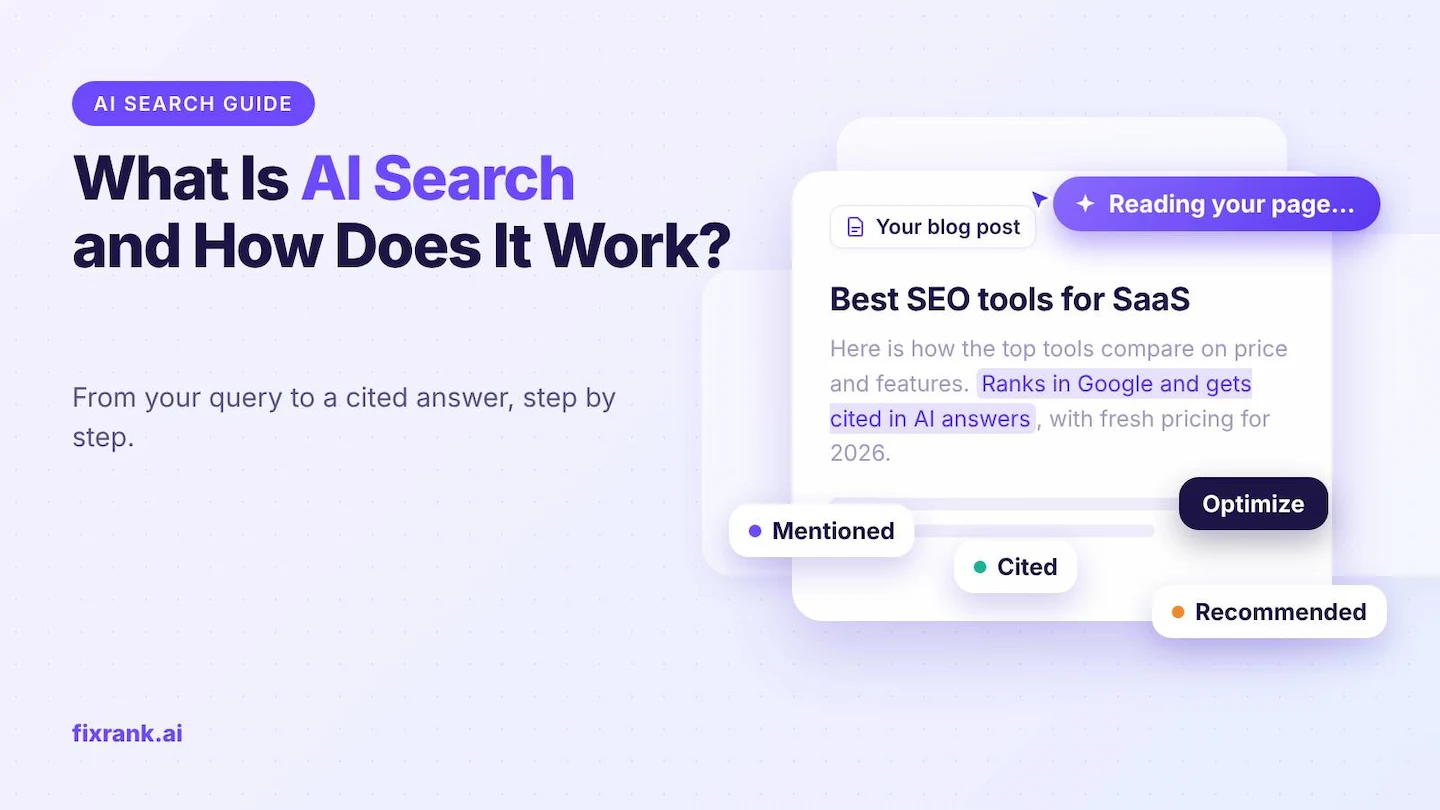
AI Search is changing how people find information online. Learn how AI Search works, how it differs from traditional search, and how to optimize your website for AI-powered search.
AI Search is changing how people discover information, products, and websites. From Google AI Overviews and AI Mode to ChatGPT, Claude, and Perplexity, users can find answers through AI-generated responses that cite relevant web pages.
Instead of simply matching words and showing a list of links, AI Search can understand a question, find relevant information, evaluate sources, and generate a direct answer. This shift is changing how people search and how businesses approach visibility.
What Is AI Search?
AI Search is a search technology that uses artificial intelligence to understand a user’s query, find relevant information, and generate an answer based on that information.
Imagine asking a helpful friend: “I want an affordable candlelight dinner near me with a rooftop setting.” A helpful answer needs to understand location, budget, experience, and preference together. AI Search works similarly. It interprets meaning and context, identifies the requirements in a question, retrieves relevant information, and generates an answer that matches the user’s intent.
AI Search is therefore more than matching keywords to pages. It attempts to understand what the user wants to accomplish.
How Does AI Search Work?
The exact process varies between platforms, but most AI Search experiences combine language models, information retrieval, and answer generation.
1. AI understands and breaks down the query
The system analyzes the words, meaning, context, and intent behind the query. For example, “I want an affordable SEO tool for my SaaS website that improves Google rankings and AI Search visibility” includes several requirements: affordability, SaaS use, Google optimization, and AI visibility.
For complex questions, the system may use query expansion or query fan-out, breaking the main question into smaller related queries.
2. AI retrieves relevant information
After understanding the query, the system looks for information that can help answer it. Depending on the platform, sources can include web pages, search indexes, databases, business information, and other connected data.
3. AI ranks and evaluates the information
The system evaluates retrieved information based on relevance, quality, freshness, and how well it matches the user’s requirements. A tool that covers technical SEO, content optimization, and AI visibility may be more relevant for the example query than a tool that only provides keyword research.
The specific ranking and evaluation methods differ between AI Search platforms.
4. AI uses retrieved information as context through RAG
Retrieval-Augmented Generation, or RAG, gives the AI model relevant reference material for the current query. Instead of relying only on its training data, the model can use information retrieved at query time.
When a system uses live web search, it can retrieve current information about news, prices, product features, and recent updates before generating an answer.
5. AI synthesizes the information
The system brings relevant pieces together to form a complete picture. It may combine pricing, use cases, features, reviews, and capabilities before deciding which information best answers the question.
6. The AI generates the answer
The Large Language Model uses the query and retrieved context to summarize, explain, compare, organize, or recommend information in natural language.
7. AI provides sources and citations
Many AI Search systems provide citations or links to sources used in an answer. These citations help users verify information and explore original pages.
For websites, this creates another form of search visibility. Content may need to rank in traditional results and also be discovered, mentioned, cited, recommended, or linked in AI-generated answers.
8. AI uses conversation context
AI Search can use previous questions and answers to interpret follow-up queries. If a user asks “which one is best?” after discussing several tools, the system can use the previous context without requiring the user to repeat the original question.
Traditional Search vs AI Search
| Traditional Search | AI Search |
|---|---|
| Focuses mainly on keywords and queries | Understands meaning, context, and intent |
| Works mainly with short queries | Handles long, conversational prompts |
| Returns ranked links and search features | Generates answers, summaries, and recommendations |
| Users click and browse multiple pages | Users can ask follow-up questions in context |
| Businesses focus on rankings and traffic | Businesses also seek mentions, citations, recommendations, and links |
| Metrics include rankings, impressions, CTR, and traffic | Emerging metrics include mentions, citations, sentiment, and AI-driven traffic |
Traditional Search and AI Search are not mutually exclusive. A website can rank in traditional results and also become a source in an AI-generated answer.
Benefits of AI Search
- Understands complex queries: Handles long, detailed, conversational prompts with multiple requirements.
- Provides direct answers: Summarizes relevant information instead of requiring users to browse many pages.
- Combines information: Brings information from several sources together for research and comparison.
- Supports conversational search: Understands follow-up questions using previous context.
- Can provide fresh information: Live retrieval can bring in current news, prices, and updates.
- Supports decisions: Can summarize, compare, explain, and recommend options based on requirements.
Limitations of AI Search
- It can generate incorrect information: A response may sound confident while misunderstanding the query or facts.
- It may rely on incomplete sources: Outdated or unavailable information can produce an incomplete answer.
- Citations are not always enough: A cited source does not automatically support every claim in the response.
- It can reduce website clicks: Users may get an answer without visiting the original website.
- Visibility is less predictable: Results can vary by query, model, source, context, location, and time.
- It can misunderstand context: Ambiguous questions, niche subjects, and real-world judgment remain difficult.
How to Optimize Your Website for AI Search
Traditional SEO remains the foundation. The additional goal is to make your website easy for AI-powered search systems to understand, trust, and reference.
1. Make your website crawlable and indexable
Ensure important pages can be crawled, indexed, and accessed by search and AI crawlers. Fix blocked resources, broken links, incorrect canonicals, accidental noindex directives, and other technical issues.
2. Answer questions directly
Create content that answers user questions clearly. Use descriptive headings, concise paragraphs, lists, definitions, examples, and supporting evidence so important information is easy to understand.
3. Build topical authority
Cover a topic comprehensively instead of relying on one page. Create related content and connect it with relevant internal links so search systems can understand relationships between subjects and pages.
4. Demonstrate expertise and trust
Support important claims with original data, research, expert insights, examples, and credible sources. Keep information accurate and update it when facts, prices, or recommendations change.
5. Structure content clearly
Use logical headings, definitions, tables, lists, descriptive URLs, and relevant structured data where appropriate. Clear structure helps search systems understand the meaning and relationships within content.
6. Optimize across AI Search platforms
Consider Google AI Overviews, Google AI Mode, ChatGPT Search, Perplexity, Claude, and other AI-powered search experiences. Their systems differ, so avoid relying on one platform or one unverified optimization tactic.
7. Monitor AI visibility
Track whether your brand or website is mentioned, cited, recommended, or linked in AI-generated answers. Combine these signals with rankings, clicks, organic traffic, and conversions.
How Do AI Search Monitoring Platforms Work?
AI Search monitoring platforms track how a brand, website, or product appears across AI-powered search results.
1. Create and run relevant prompts
The platform creates prompts related to a brand, product, industry, or audience and runs them across supported AI Search platforms.
2. Analyze AI responses
It checks whether a brand or website appears and identifies how and where it appears in the response.
3. Measure AI visibility
Platforms can track mentions, citations, recommendations, source links, position, sentiment, and other visibility signals. FixRank AI includes AI visibility analysis as part of broader SEO intelligence, helping teams identify opportunities to improve search visibility.
4. Compare competitors
Some platforms compare visibility for similar prompts, showing which brands are mentioned, cited, or recommended more often.
5. Track changes over time
AI Search results change based on prompt wording, platform, sources, time, geography, and conversation context. Running the same prompts over time helps identify meaningful trends.
How to Measure Your AI Search Visibility
Track several signals rather than treating one score as the complete picture:
- Mentions: How often AI systems mention your brand or product.
- Citations: How often your website is used as a source.
- Recommendations: How often your brand or product is recommended.
- Source links: How often AI responses link back to your website.
- Competitive presence: How your visibility compares with competitors.
- AI-driven traffic: Referrals and conversions coming from AI Search through analytics.
A mention, citation, recommendation, and website visit represent different levels of visibility. Compare the same relevant prompts over time and inspect the actual response context where possible.
The Bottom Line
AI Search is changing how people discover and consume information. Instead of simply matching keywords and showing links, it can understand queries, retrieve relevant information, evaluate sources, and generate direct answers.
For businesses, search visibility is no longer only about ranking in traditional results. Your website also needs to be easy to discover, understand, trust, and reference in AI-generated answers.
Traditional SEO remains the foundation. Create useful content, maintain strong technical SEO, build topical authority, and monitor AI Search visibility to improve your chances of being mentioned, cited, recommended, and linked across modern search experiences.
Frequently Asked Questions
What is Google’s AI Search called?
Google uses names such as AI Overviews and AI Mode for its AI-powered search experiences. These features can provide generated responses alongside links to supporting web sources.
Does AI Search use live information?
Some systems use RAG to retrieve relevant information and provide it to the AI model as context. When connected to live web search, retrieval can bring in current events, prices, and recent updates.
Does AI Search replace Google Search?
Not completely. AI Search is changing how people interact with search, while traditional search remains important. Google itself is evolving Search with AI Overviews and AI Mode.
Why is AI Search visibility important for businesses?
People can discover businesses through AI-generated answers as well as traditional search results. Being mentioned, cited, or recommended can become another way for potential customers to discover a brand.
Can the same website appear in traditional and AI Search?
Yes. A website can rank in traditional search results and also be used as a source in an AI-generated answer. Technical SEO, useful content, and clear information support both types of visibility.
Ready to Fix Your SEO Automatically?
Discover technical issues, improve AI visibility, optimize internal links, and unlock measurable ranking growth with FixRank AI.
Start Free Audit